57 kzone

  • Subscribe to our RSS feed.
  • Twitter
  • StumbleUpon
  • Reddit
  • Facebook
  • Digg

Saturday, 6 April 2013

Interplay of exercise and ketosis – Part I « The Eating Academy | Peter Attia, M.D

Posted on 14:48 by Unknown
The interplay of exercise and ketosis – Part I « The Eating Academy | Peter Attia, M.D.

The interplay of exercise and ketosis – Part I

The interplay of exercise and ketosis – Part I

Share
I embarked on a self-experiment last weekend to see if I could better understand the interplay between the different types of exercise I do and ketone production (beta-hydroxybutyrate, or B-OHB, to be specific).  To be clear, nothing I do with a sample size of one “proves” anything, but sometimes self-experiments can help you formulate hypotheses and, if nothing else, understand how your body works.  Consider the parable of the black sheep.  If you see even a single black sheep in the field, depending on your field of training, you can draw conclusions:
Three scientists were on a train and had just crossed the border into Scotland. A black sheep was grazing on a hillside. The biologist peered out of the window and said, “Look! Scottish sheep are black!” The chemist said, “No, no. Some Scottish sheep are black.” The physicist, with an irritated tone in his voice, said, “My friends, there is at least one field, containing at least one sheep, of which at least one side is black some of the time.”
My point is, even a self-experiment of one can be good for something.

To test the relationship between exercise and ketosis I decided to examine my blood levels of glucose, B-OHB, and lactate immediately before and after three different types of workouts on three successive days.  This interplay is complex and no one knows “everything” about it, including the world’s experts (which I am not pretending to be).  I’m going to try to balance a fine line in this post – I want to be rigorous enough to explore the ideas with substance but not too detailed to put you to sleep.  I hope I am able to balance these forces adequately.

If any of you are not familiar with the work of Jeff Volek and Steve Phinney, but you are interested in the biochemistry of nutritional ketosis, I recommend getting familiar with their work.  The list of people who know more about nutritional ketosis is short.

Let’s take a look at the three parameters I measured in a bit more detail.  To give you a sense of what is “normal” here are some guidelines:

Glucose

A normal fasting glucose is generally considered to be between 75 and 100 mg/dL.  My mean over the past year has been about 90, but I need to mention two very important caveats:
  1. On the four occasions I have calibrated my hand-held device with an actual laboratory test, my device seems to run high by about 11 mg/dL, so a measurement of 95 mg/dL on my device is probably closer to 84 mg/dL in reality.
  2. I carry a genetic trait for a disease called beta-thalassemia.  The clinical manifestation of this is that I have much smaller red blood cells than normal (about 65% of normal size).  There is some evidence in the literature that this condition prevents some accurate testing of any assay that can interfere with hemoglobin.  For example, a test measuring glycosylated hemoglobin suggests I have much more glucose in my blood than is actually measured. In fact, the Glycomark test for mean post-meal glucose level suggested I have an average post-meal glucose level of 190 mg/dL which is obviously not true.  In other words, something about my beta-thalassemia seems to interfere with, at the very least, measuring glucose linked to hemoglobin, and possibly measuring glucose in general.
I mention these 2 features to say my glucose levels (unlike B-OHB and lactate which I’ve documented to be very accurate) may be artificially elevated. Here’s the important part, though: the discrepancy seems to be constant, so the increases or decreases seem to be good measurements.

Beta-Hydroxybutyrate (B-OHB)

A normal fasting B-OHB level for a “normal” (i.e., non-ketotic) person is zero.  Within a day of fasting, you might expect this number to reach 0.2 to 0.4 mM, and about 1.0 mM within 48 to 72 hours of complete fasting, though this is highly variable among subjects.
If you’ll recall from my discussion of keto-adaptation, the threshold for nutritional ketosis is about 0.5 mM.  My normal morning fasting level of B-OHB is usually between 1.0 and 2.0 mM with an arithmetic mean of about 1.4 mM.
Both insulin and glucose (probably by causing the secretion of insulin) suppress ketones. This is why, for example, consuming more than about 50 gm of carbohydrates per day and/or more than about 120-150 gm of protein per day makes it difficult to be in nutritional ketosis – too much insulin secretion.

Lactate

Lactate (or lactic acid) is a byproduct of anaerobic exercise.  A normal level is considered to be below 2.2 mM.  Basically (I’m oversimplifying a bit), when you exercise in a predominately aerobic capacity, while you do generate lactate your liver is able to match muscle production with clearance via a process called the Cori Cycle (a process in which the liver turns lactate back into glucose).
If you’ve ever done a very intense exercise – like run an all-out mile – and felt like your body is completely seizing up and you are unable to move, you’ve experienced a high lactate.  Technically, the lactate is not causing this.  Lactate gets a pretty bad rap, and it’s actually a good thing as it allows us to generate energy even when we demand it in an environment where sufficient cellular oxygen is absent.  The real “bad guy” is the hydrogen ion that accompanies lactate and interferes with the ability of our muscles to contract and relax properly.  However, we use lactate as a proxy for the hydrogen that is actually causing the pain and difficulty in muscle contraction.
For me (personally, though this is probably true for most people) the highest lactate I generate tends to be in all-out activities lasting about 2 minutes which use all muscles in my body (the more muscles you use, the more lactate you generate).  Hence, the 200 individual medley (IM) race generates the most lactate in my body: It’s 2-plus minutes of maximum exertion sending pain into every muscle in my body (this event requires a swim, in order, of 50 yards each of all-out butterfly, then backstroke, then breaststroke, then freestyle). A runner would probably concur that the 800 meter (half-mile) run is one of the most painful races in that sport.
The highest lactate I have ever measured in myself, following a 200 IM race, was about 16 mM.  I have measured higher levels in several Olympic swimmers, including 20.2 mM in one (as he was vomiting all over the pool deck – for reasons I’ll try to remember to explain in a subsequent post). On my bike, where I’m mostly using my legs, obviously, I think my highest recorded lactate measurement was about 12 or 13 mM following a set of ten 2-minute all-out hill repeats.
I measure my lactate levels using a different hand-held device from the one that measures glucose and B-OHB.
[Another parable, this time about marriage: 2 years ago my father asked me what my wife and I wanted for Christmas.  I said “we” wanted a lactate meter with about 200 test strips (I think it was about $900 for everything).  He looked at me funny, but figured I knew what I was talking about.  When Christmas rolled around and “we” got “our” lactate meter I had to spend a few minutes explaining to my wife why this was a perfect gift for “us” as it allowed “us” to spend lots of time together while she pricked my finger for blood during my workouts.  She didn’t really agree with me.  I clearly don’t understand women very well – I really thought she would find this device “cool.” Which is why this is a blog about health, not marriage.]

Results from my experiment


Day 1: Saturday (hard swim workout, race pace)

This was a one hour, 45 minute swim with warm-up and cool down.  The “main set” was mostly freestyle and butterfly at all-out race pace for distances of 25, 50, 75, and 100 yard intervals with long rest (1:2 – 2 times more rest than swim time) for the all-out 100 yard swims, and modest rest (2:1 – half the rest time of each swim).  The single most demanding aspect of this workout took place with about 25 minutes remaining and, though I didn’t measure peak lactate, I suspect it was around 12-14 mM, based on the discomfort I experienced. I was surprised that my lactate level was still as high as it was (see below) 25 minutes later, though I suspect I didn’t cool down as gingerly as I should have, to optimize for maximum lactate clearance.
During this workout I consumed nothing and prior to the workout I consumed my usual 40 mL of medium chain triglyceride (MCT) oil.
At 7:29 am, just before beginning the workout, my glucose was 86 mg/dL, B-OHB was 0.7 mM (which is low for my fasting level), and lactate was 1.9 mM.
Immediately post-workout, at 9:14 am, my glucose was 118 mg/dL, B-OHB was 1.0 mM, and lactate was 7.2 mM.

Day 2: Sunday (long ride, 80% of race pace)

This was a tempo ride covering 104 miles (167 km) with 5,600 feet of climbing.  Average pace was 17 mph (about 28 km/hr) with lots of headwind.  My average HR over this 6 hour ride was 141 and average power output was between 190 and 200 watts.   There were many sections of the ride, particularly on the climbs, where my HR was sustained in the 160’s for 30 minute stretches and power output was above 275 watts (which, for me, means my muscles generate lactate faster than my liver can clear it).
During this workout I consumed the following:
  1. Two single-serving packets (1 oz) of cream cheese (14 gm fat; 2 gm carb; 2 gm protein)
  2. 50 gm of super starch, by Generation UCAN mixed in my water bottles (50 gm super starch which, technically, is a carb but does not behave like one with respect to insulin secretion and ketone suppression – I will write a dedicated post on super starch in the future, but if you must try it now, use this code to get a discount: “UCANPA”)
  3. 2.5 oz of mixed nuts (25% of each almonds, cashews, walnuts, peanuts – 36 gm fat; 14 gm protein; 15 gm carb)
Total intake during 6 hour ride, therefore, was: 50 gm fat; 16 gm protein; 67 gm carb (of which 50 gm was super-starch), for a total of about 750 calories.
About 90 minutes prior to the ride I consumed 4 eggs fluffed with heavy cream, cream cheese, coffee with heavy cream, and my usual 40 mL of MCT oil.
At 7:56 am, my glucose was 88 mg/dL, B-OHB was 1.3 mM, and lactate was 1.7 mM.
Immediately post-ride, at 2:39 pm, my glucose was 74 mg/dL, B-OHB was 4.4 mM, and lactate was 2.2 mM.

Day 3: Monday (dry-land, high intensity training)

If you’ve seen the video from my post, my pet peeve, you’ll understand what I do during dry-land high intensity training. On this particular day, however, it was raining (one of 3 days a year this happens in San Diego), so I did not do the outdoor stuff (including tire flips).  Main sets included a lot of the stuff you can see in that video with a few (nearly as painful) substitutions.
Prior to the workout I consumed nothing other than my usual 40 mL of MCT oil and during the workout I consumed about 4 gm of branched chain amino acids (BCAA) and 10 gm of super starch mixed in my water bottle – so essentially just water.
Immediately prior to the workout, at 6:43 am, my glucose was 77 mg/dL, B-OHB was 3.5 mM*, and lactate was 1.6 mM.
At 7:52 am glucose was 132 mg/dL, B-OHB was 2.2 mM, and lactate was 5.4 mM.
*If you’re wondering why my fasting B-OHB level was so high (recall, I’m usually between 1.0 and 2.0), I suspect it’s at least a partial result of 2 things:
  1. Residual fat breakdown from the previous day’s long ride and caloric deficit, and
  2. On Sunday night I ate (no exaggeration) about half a gallon of my wife’s famous zero sugar, high fat coffee ice cream, which must be the closest thing I’ve ever experienced to heroin in terms of addiction potential.

Summary

The figure below summarizes the data from the mini-self-experiment I just described.
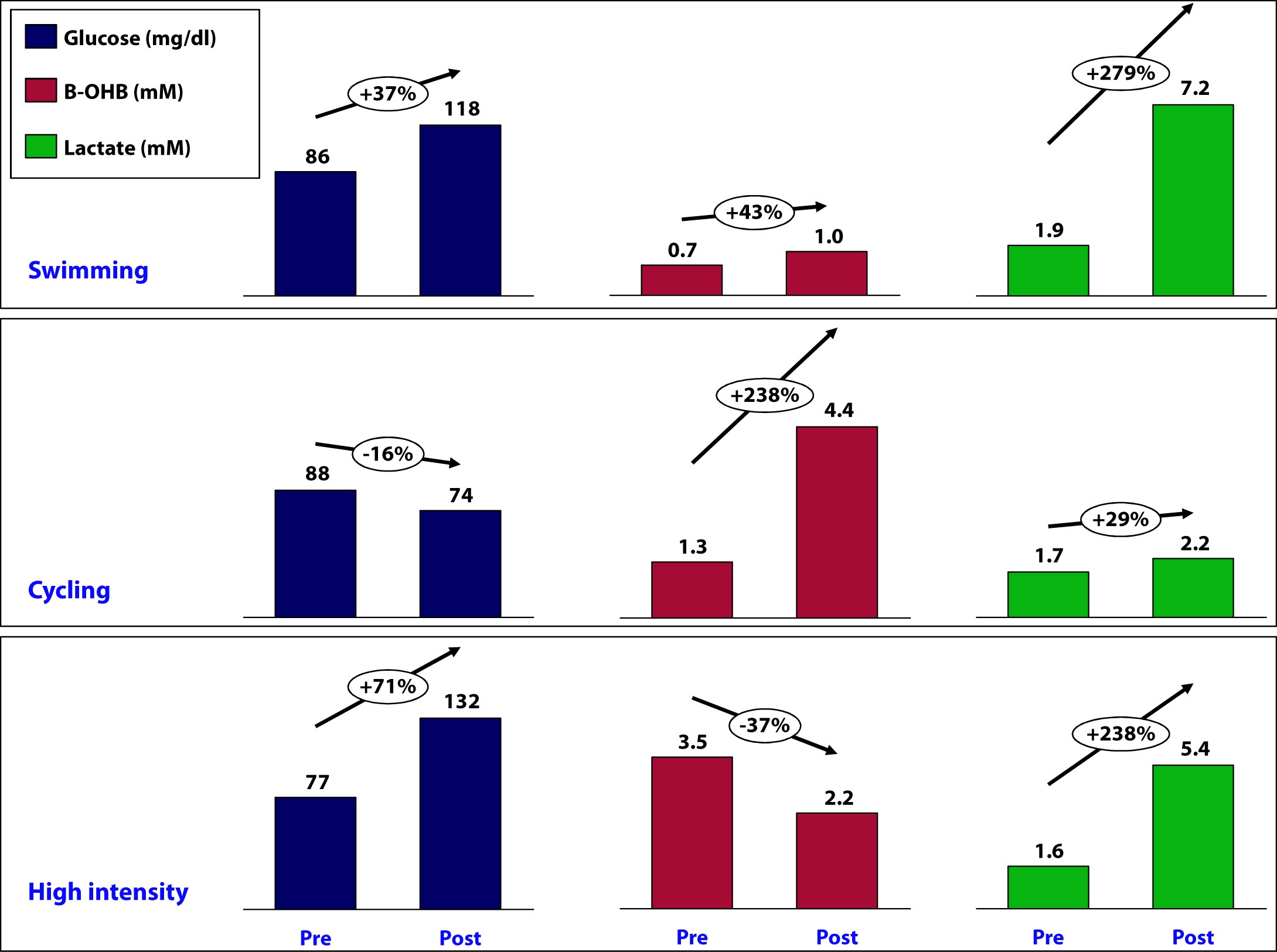
Exercise summary data
What can we learn about the interaction between glucose, B-OHB, and lactate?
How does super starch impact my ketosis?
Is ketosis helping me or hurting me?
Stay tuned for next week, when I will try to interpret these results…
7
MAR
260


Related Posts

  • The interplay of exercise and ketosis – Part II
  • Introduction to Superstarch – Part II
  • Introduction to Superstarch – Part I
  • Ketosis – advantaged or misunderstood state? (Part II)
  • What I actually eat, part II – “IFIK”
Read More
Posted in | No comments

Friday, 5 April 2013

2013 NSCA Personal Trainers Conference: Looking Back at my Debate with Dr. Jeff Volek | Alan Aragon's Blog

Posted on 23:56 by Unknown
2013 NSCA Personal Trainers Conference: Looking Back at my Debate with Dr. Jeff Volek | Alan Aragon's Blog

2013 March 13
by Alan Aragon
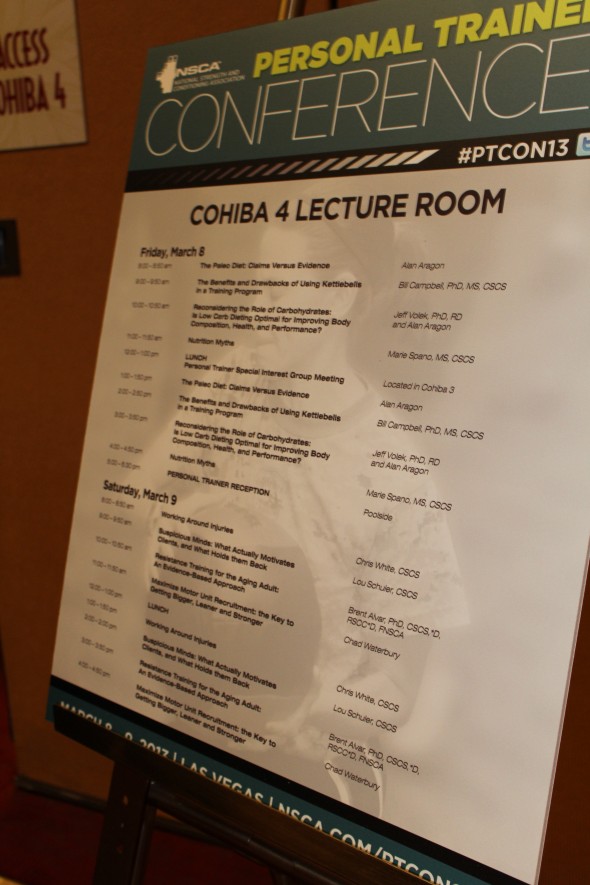
lecture schedule
Fun…..but Fricking NUTS!

My second consecutive year presenting at the NSCA Personal Trainers Conference was one of the most rewarding, and definitely the most hectic speaking experience I’ve ever had. The way it works is that speakers do their presentation twice throughout the weekend so the audience has a greater chance of not missing them. As fate would have it, I was the only speaker in the lineup doing two presentations: a Paleo diet dissection & a carbohydrate debate. This means that I presented four times — and all four presentations were scheduled on one day (Friday). If the NSCA had a surprise hazing for me in mind, they definitely succeeded.

In order to avoid being a full-length novel, this blog post will skip the Paleo stuff (there’s plenty of that in AARR) and focus on the juicier highlight of the conference: my debate with low-carb icon Jeff Volek.

Dr. Volek 101

For anyone unaware, Jeff Volek is one of the world’s most prolific & influential low-carb diet researchers. He’s an associate professor at the University of Connecticut (full bio here). He’s also one of the authors of the latest installment in the Atkins bestseller saga, New Atkins for a New You. Many consider him to be the top guy in this area of study. When I agreed to debate a low-carb advocate, I had no clue who’d end up on the other side of the cage. When I got word that it was THE Dr. Jeff Volek, imagine my excitement as someone who has been intrigued by his work since the late nineties. I’ve always viewed him as the “Rebel RD.” This is because about 10 years ago when his name started regularly appearing in major magazines, he was the only registered dietitian who openly endorsed low-carb/ketogenic dieting. The rest of the low-carb RDs – if they existed at all – were afraid of reproach by the American Dietetic Association.

Volek’s Case

The topic was carbohydrate intake for athletic performance (and to a lesser degree, health). The planned format was for Jeff & I to present our case (via Powerpoint) for 15 minutes each, leaving another 20 minutes for free-flowing discussion and audience Q & A. So, it was more like a point/counterpoint thing than a traditional debate. Jeff went first and ran about 10 minutes over his limit, then I went on for a slightly shorter period. There was no time left for discussion since the whole affair was less than an hour before we had to clear out of there for the next presenter. So, only 50 minutes for a debate between Volek and Aragon? Yes.  But it was an action-packed 50 minutes, that’s for sure. I’ll do my best to sum it up as follows.

Jeff began by discussing the problem of endogenous fuel stores in the context of endurance competition. While we only have roughly 1200-2000 kcals of glycogen, we’ve got at least 40 times that amount of energy stored in the adipose tissue. So, why not train the body to become adept at tapping into this nearly bottomless well of energy we carry around like designer luggage? Jeff then discussed the physiology of carbohydrate-mediated insulin elevations acting as a brake on fat mobilization & oxidation during exercise. He then illuminated the erroneous conflation of a relatively benign condition he calls nutritional ketosis with an adverse condition called ketoacidosis. He drove the point that ketosis has gotten a bad rap, and that ketones are a perfectly viable fuel source for not just brain functioning in the absence of exogenous carbohydrate availability, but also to support endurance capacity.
He then discussed research by Phinney et al [1], claiming a maintenance of endurance capacity in well-trained cyclists despite 4 weeks of a ketogenic diet for the purpose of inducing “keto-adaptation” – a physiological shift towards more efficiently deriving energy from ketones and fat. Jeff proposes that “hitting the wall” due to glycogen depletion in endurance competition can be avoided once an athlete becomes keto-adapted (also referred to as being fat-adapted), and thus more able to tap into stored fat for fuel. He also discussed a study where overweight/obese subjects on a resistance training program lost more fat on a low-carb diet than a low-fat diet [2]. I challenged Jeff on the methodology of this study when he brought it up again in the second lecture – more on that in a bit. Jeff concluded his lecture by contending that a growing minority of endurance competitors have successfully employed the low-carb approach, and that he’s not the only guy challenging conventional wisdom. To my amusement, he chose to use Tim Noakes’ recent (and rather dramatic) low-carb epiphany as evidence that he’s not alone on this.
My Turn
The aim of my presentation was to present controlled research, observational research, and client case studies collectively showing that the narrow position of low-carb supremacy simply does not hold much evidential weight. I began by discussing the current state of affairs in the low-carb versus low-fat experimental research, which is best summed up in a recent meta-analysis by Hu et al (the largest of its kind) showing a general lack of difference in effectiveness for improving metabolic risk factors, including weight reduction [3].
I went on to examine the common methodological limitation of low-carb versus low-fat comparisons failing to match protein intake. As such, the advantage of greater thermic effect, satiety, and lean mass retention will strongly favor the groups whose protein is optimized, or at least adequate. Low-fat/high-carb treatments often fall short of adequate protein intake, and the disadvantages are inherent. A memorable example showing significantly greater effects on mood and a lack of significant difference in body composition improvement from  a non-ketogenic diet compared to a ketogenic diet was by Johnston et al [4]. This study showed a trend toward more favorable effects in the non-ketogenic diet group, and the important detail is that protein intake was similar between groups, and significantly above the paltry RDA level. 
It was serendipitous that Jeff brought up Phinney et al’s 1983 study on highly trained cyclists [1], because I was well-prepared to expose its details. This study involved 5 subjects who, after 1 week on a conventional diet, were put on a ketogenic diet for 4 weeks. Both phases were eucaloric (weight-maintaining). By the end of the 4 weeks, the subjects’ steady-state respiratory quotient (RQ) dropped from 0.83 to 0.72, indicating that they indeed were fat-adapted. Exclusive carbohydrate utililzation is indicated by an RQ of 1.0 while the exclusive utilization of fat is indicated by an RQ of 0.7, so with an RQ just a hair above that, these subjects were thoroughly primed for the proposed benefits of keto-adaptation.
Stick with me now… Pre and post-keto-adaptation endurance capacity (measured by time to exhaustion or TTE) was not significantly different. This lead the authors to conclude that aerobic endurance at 62-64% of VO2max was not compromised by the 4-week ketogenic diet phase. Mean TTE in the non-keto and keto conditions were 147 and 151 minutes, respectively. However, the authors’ conclusion is misleading since 2 of the 5 subjects experienced substantial drops in endurance capacity (48 & 51-minute declines in TTE, to be exact). One of the subjects had a freakishly high 84-minute increase in TTE, while the other increases were 3 & 30 minutes. The outlying high value was instrumental in skewing the results away from any significant decline in the keto condition’s mean TTE.
I proceeded to discuss how 21 years after the aforementioned study [1], Phinney wrote a review in which he reflects upon the ergolytic (performance-compromising) effect of the ketogenic diet phase, stating the following (my bolding for emphasis) [5]:
“The bicyclist subjects of this study noted a modest decline in their energy level while on training rides during the first week of the Inuit diet, after which subjective performance was reasonably restored except for their sprint capability, which remained constrained during the period of carbohydrate restriction.“
For the record, I have Anthony Colpo to thank for catching the above tidbit. The point is, any decrease in sprinting capability can be considered a crucial liability, especially since most endurance races involve sprinting at various points. Almost invariably, sprinting to some degree occurs toward the final stretch to the finish line.
The final segment of my presentation was a discussion of observational research including the carb-dominant dietary habits of the Blue Zone populations, who are among the longest-living and most disease-resistant in the world. I also discussed the carb-heavy diets of East African distance runners, who hold over 90% of the all-time world records and also the current top-10 positions in world ranking [6,7]. I concluded my lecture by relaying client case studies of high-level competitive & professional athletes, whose daily carbohydrate gram intakes ranged the high double-digits to the high triple-digits. My point was to illustrate the sprawlingly wide range of carbohydrate requirements across individuals, as opposed to the one-size-fits-all ideology of low-carb absolutists. Here’s the slide that put faces to the case studies of my athlete clientele over the years:
clients
The Repeat Round
As I mentioned, every presentation at the conference was delivered twice, and my debate with Jeff was no exception. This made for a very odd second round, since we both knew each other’s material. The moderation was tighter on this round, and the 15-minute Powerpoint presentation limits were strictly imposed to ensure some discussion time. Jeff appeared to portray more flexibility in his position. He opted to go first again after I asked him what he preferred. He was thus able to pre-empt my mentioning of inter-individual differences in the Phinney study, and pad it with the idea that the authors expected a much worse outcome after the keto phase, but were surprised that it didn’t completely obliterate performance.
In the discussion following our presentations, Jeff once again brought up a resistance training study [2] showing the benefits of low-carb versus low-fat. Unfortunately, this study is not readily accessible, nor is it peer-reviewed. In any case, I asked Jeff if protein intake was matched between groups, and he conceded that it was not. This opens up the possibility that a significantly higher protein intake in the low-carb group could have induced greater satiety and less overall caloric intake, resulting in greater fat loss. Again, a failure to match protein (let alone match optimized intakes, which under dieting conditions would be at least double the RDA) is a frustratingly common confounder in these types of studies.
When I asked Jeff how we can reconcile the high-carb diets of the vast majority of world-class endurance champions, he proposed that these populations simply have not given low-carbing a fair enough shot. To me, this is quite a stretch since the best in the world would be foolish to jeopardize what has been working so stunningly well since the beginning of organized endurance competition. When Jeff was challenged on the concept of chronically depleted or low glycogen levels compromising the capacity for muscle growth, Jeff deflected to his current concentration on the clinical applications of carbohydrate restriction rather than hypertrophic applications per se.
Did I feel that Jeff did an excellent job presenting his side and delivering useful information? Yes, and I have a tremendous amount of respect for him and his body of work. However, judging from my own observations – as well as the feedback from others – he simply did not bring a comparatively compelling case for a low-carb/ketogenic diet’s application to competitive athletes. In contrast, I was able to present multiple lines of evidence showing the benefit of both ends of the carbohydrate intake spectrum, and many points in between.
Postscript
Overall, I enjoyed the conference immensely. I didn’t get a chance to see all of the presentations I wanted to, but the ones I was able to catch (by Brad Schoenfeld, Bret Contreras, Chad Waterbury, Lou Schuler, Marie Spano, and Mark Nutting) were top-notch. All of them delivered theoretical and practical gems of knowledge, and I can’t express enough how high the quality of education is. A large debt of gratitude is owed to Jeff Volek for agreeing to share the stage and lock horns with me. Huge thanks & kudos are due to the tireless administrators of the NSCA (special shout-outs to Peter Melanson & David Barr) for making this an event to remember.
References
  1. Phinney SD, Bistrian BR, Evans WJ, Gervino E, Blackburn GL. The human metabolic response to chronic ketosis without caloric restriction: preservation of submaximal exercise capability with reduced carbohydrate oxidation. Metabolism. 1983 Aug;32(8):769-76. [PubMed]
  2. Quann, EE. Carbohydrate restricted diets and resistance training: a powerful combination to enhance body composition and improve health. ACSM’s Certified News. Oct-Dec, 18(4), 2008.
  3. Hu T, Mills KT, Yao L, Demanelis K, Eloustaz M, Yancy WS Jr, Kelly TN, He J, Bazzano LA. Effects of low-carbohydrate diets versus low-fat diets on metabolic risk factors: a meta-analysis of randomized controlled clinical trials. Am J Epidemiol. 2012 Oct 1;176 Suppl 7:S44-54. [PubMed]
  4. Johnston CS, Tjonn SL, Swan PD, White A, Hutchins H, Sears B. Ketogenic low-carbohydrate diets have no metabolic advantage over nonketogenic low-carbohydrate diets. Am J Clin Nutr. 2006 May;83(5):1055-61. [PubMed]
  5. Phinney SD. Ketogenic diets and physical performance. Nutr Metab (Lond). 2004 Aug 17;1(1):2.Phinney SD. Ketogenic diets and physical performance. Nutr Metab (Lond). 2004 Aug 17;1(1):2. [PubMed]
  6. Beis LY, Willkomm L, Ross R, Bekele Z, Wolde B, Fudge B, Pitsiladis YP. Food and macronutrient intake of elite Ethiopian distance runners. J Int Soc Sports Nutr. 2011 May 19;8:7. doi: 10.1186/1550-2783-8-7. [PubMed]
  7. Onywera VO, Kiplamai FK, Boit MK, Pitsiladis YP. Food and macronutrient intake of elite kenyan distance runners. Int J Sport Nutr Exerc Metab. 2004 Dec;14(6):709-19. [PubMed]  
[GO HERE TO
Read More
Posted in | No comments

Thursday, 4 April 2013

How Much to Deadlift For Your Body Weight? | LIVESTRONG.COM

Posted on 02:17 by Unknown
How Much Are You Supposed To Deadlift For Your Body Weight? | LIVESTRONG.COM

 How Much Are You Supposed to Deadlift for Your Body Weight?

The amount you deadlift gets determined by more than your body weight. Your strength levels, skill and gender all play a role. A small, novice lifter will deadlift far more than a massive, elite powerlifter. When selecting a training weight, remember that you must never compromise technique -- train your body, not your ego. Consult a health care practitioner before beginning any strength training program.

Untrained and Novice

As an untrained deadlifter, you should not worry about poundage; learn technique first. Then practice your technique. The weight increases will take care of themselves. An average male novice will deadllift approximately 133 percent of his bodyweight. An average female novice will deadlift 101 percent of her bodyweight, according to Lon Kilgore, Ph.D., one of the authors of "Practical Programming for Strength Training."
Sponsored Links
Pilates Classes Melbourne Improve posture, flexibility and core strength. Alleviate back pain. www.sofit.com.au

Intermediate

An intermediate lifter has been training nearly one to two years. Technique has been developed, and strength built through many repetitions of the deadlift. If you are a male intermediate deadlifter, on average you will lift approximately 150 percent of your bodyweight. If you are a female intermediate lifter, you will lift approximately 118 percent of your bodyweight. Many intermediate lifters move on to become novice powerlifters.

Advanced

As an advanced lifter, you will have clearly defined goals -- all of which are athletic-based. Many powerlifters fall into this category, as well as competitive weightlifters. Some bodybuilders and many strongman competitors remain in the heavier weight classes. As an advanced male, you should deadlift at least 210 percent of your bodyweight. As an advanced female, you should deadlift at least 160 percent of your bodyweight.

Elite

Elite athletes are long-time strength sport competitors. They have been competing in strength sports for years, including powerlifting, weightlifting, strongman competitions and the highland games. An elite male strength athlete will usually deadlift at least 260 percent of his bodyweight. An elite female strength athlete will usually deadlift at least 200 percent of her bodyweight on average.

References

  • "Practical Programming for Strength Training"; Mark Rippetoe, et al.; 2009
  • "The Westside Barbell Book of Methods"; Louie Simmons; 2008
Article reviewed by BudK Last updated on: Aug 20, 2011

Read more: http://www.livestrong.com/article/521854-how-much-are-you-supposed-to-deadlift-for-your-body-weight/#ixzz2PU6BViIs
Read More
Posted in | No comments

Strength level calculator: measure ability in common exercises

Posted on 01:55 by Unknown
Strength level calculator: measure ability in common exercises such as the deadlift, clean and press, bench press, squat and power clean

Male strength tables (metric)

These tables are available for men and women measured in either metric (kg) or imperial (lb). You can get a more accurate rating of strength using the strength level calculator.

Bench press

Body /kg Untrained Novice Intermediate Advanced Elite
60 42 62 81 101 121
70 45 66 87 108 129
80 48 70 92 115 137
90 50 74 98 122 145
100 53 78 103 128 154
110 56 83 109 135 162
120 59 87 114 142 170
130 62 91 120 149 178
140 65 95 126 156 186
150 68 99 131 163 195

Power clean

Body /kg Untrained Novice Intermediate Advanced Elite
60 33 54 74 95 115
70 36 57 79 101 123
80 38 61 84 107 131
90 40 65 89 114 138
100 42 68 94 120 146
110 45 72 99 126 154
120 47 76 104 133 161
130 49 79 109 139 169
140 52 83 114 145 177
150 54 87 119 152 184

Clean and press

Body /kg Untrained Novice Intermediate Advanced Elite
60 29 40 51 62 73
70 31 43 55 67 79
80 32 45 59 72 85
90 34 48 63 77 91
100 35 51 66 82 97
110 37 54 70 87 103
120 39 56 74 92 109
130 40 59 78 97 116
140 42 62 82 102 122
150 43 64 85 107 128

Squat

Body /kg Untrained Novice Intermediate Advanced Elite
60 43 75 107 139 171
70 46 80 114 148 182
80 49 85 121 157 194
90 52 90 128 167 205
100 55 95 135 176 216
110 57 100 143 185 228
120 60 105 150 194 239
130 63 110 157 204 250
140 66 115 164 213 262
150 69 120 171 222 273

Deadlift

Body /kg Untrained Novice Intermediate Advanced Elite
60 54 91 129 166 204
70 58 97 136 175 214
80 63 103 143 184 224
90 68 109 151 192 234
100 72 115 158 201 244
110 77 121 165 210 254
120 82 127 173 218 264
130 86 133 180 227 274
140 91 139 187 236 284
150 95 145 195 244 294
Read More
Posted in | No comments

Deadlift: Test Your Strength - Men's Fitness

Posted on 01:51 by Unknown
Deadlift: Test Your Strength - Men's Fitness

Find out how strong you are and how to get stronger

By CJ Murphy

THE TEST

Estimate your deadlift one-rep max—the most weight you can lift for one rep—and compare it to the calculations below.
Your 1RM (one-rep max) is...
  • Less than your body weight = Damn, you're weak
  • 1.25 x your body weight = You're average
  • 1.5 x body weight = You're pretty strong
  • 2 x body weight = You're a beast!
A 200-pound guy who can deadlift 300 pounds for one rep is pretty strong. If your number falls in the weak or average categories, see below for tips on how to bring it up.

BRINGING UP YOUR LIFT

If you bombed out on our test, try these tips.

1) As you lift the bar on a rep, increase your speed. Start firmly from the floor and try to go faster as you approach the locked-out position.

2) Try the workout below. Make it your first session of the week each week.

Week 1: Deadlift standing on a 45-pound plate. Five sets of five reps, resting one to two minutes between sets. Use the same weight on all five sets.

Week 2: Deadlift standing on two 45-pound plates. Five sets of five reps, resting one to two minutes between sets. Use the heaviest weight possible for each set.

Week 3: Perform good mornings. Set up as you would for a squat but point your feet straight ahead. Now brace your abs and push your hips back as far as possible. Keep the arch in your lower back as you bend forward at the hips as far as you can—you must keep this arch at all times. Extend your hips to return to the starting position. That's one rep. Work up to one working set with a weight that allows you only three reps.

Week 4: Same as Week 3.

Week 5: Deadlift standing on two 45-pound plates. Three sets of three reps, resting one to two minutes between sets.

Week 6: After a thorough warm up, test your one-rep max. It should be significantly higher.

See Also:
Beginner Weight Training
Strength Training
Workout Routines


Strength is the foundation of performance. When all else is equal, a strong guy will run faster, hit harder, and last longer than a weakling. Find out how strong you are with the deadlift, which tests your legs, hips, back, and grip.

HOW IT'S DONE

Stand with your feet about hip-width apart, your toes facing straight ahead. Squat down and grab the bar with an outside-shoulder-width, palms-down grip [1]. Keep your lower back in its natural arch, and drive your heels into the fl oor and push your hips forward, lifting the bar as you rise until it's in front of your thighs [2]. Reverse the motion and return the bar to the fl oor. That's one rep.
Read More
Posted in | No comments

Trap Bar Deadlift (www.trainatp.com) - YouTube

Posted on 01:44 by Unknown


gshinoskiegshinoskie·449 videos
500
Read More
Posted in | No comments

How to Gain Weight with Just One Exercise - How to Build Muscle | Strength Training Workouts | Mass Gain Diet | How to Build Muscle | Strength Training Workouts | Mass Gain Diet

Posted on 01:17 by Unknown
How to Gain Weight with Just One Exercise - How to Build Muscle | Strength Training Workouts | Mass Gain Diet | How to Build Muscle | Strength Training Workouts | Mass Gain Diet

When people ask me how to gain weight the first thing I ask them is if they do deadlifts. If you are trying to get big but aren’t including deadlifts in your program you are wasting your time. There is simply no more effective mass building exercise than the deadlift.

From your neck to your calves, nearly every muscle in your body gets activated and receives a powerful growth stimulus from deadlifts.

Not only is the deadlift the most effective mass building exercise there is but it is also the most basic ,and has the greatest carryover to the real world. There aren’t many times in life where you would lie down on your back and press a weight up over your chest like you would during a bench press. But hardly a day goes by when you don’t bend down and pick something up off the floor. And that is what you do when you deadlift. So it trains you for real life situations and helps to prevent the oh-so-common lower back problems that plague hundreds of thousands of adults due to incredible weakness.
But the bottom line for all skinny guys and aspiring mass monsters is that if you want to know how to gain weight, you gotta learn how to deadlift.

Although the deadlift works the entire body from head to toe, it is especially effective at building huge traps, upper back muscles, spinal erectors, glutes, hamstrings and forearms. Plenty of puffed up bodybuilders have the big pecs and biceps but a deadlifter stands out from the crowd,  looking powerful and intimidating with the mountainous traps and thick, ruggedly muscled upper and lower back.

To perform a proper deadlift, stand directly over the bar with your shins nearly touching it and feet approximately 8-14 inches apart. Squat down by breaking at the hips and pushing your glutes back. Keep your back tightly arched, chest up and head in line with your spine. Your upper body should be at a 45 degree angle in relation to the ground. Grab the bar with a vice grip and begin to pull up and back. As the bar passes your knees, drive your hips forward powerfully, push your chest out and pull your shoulders back to lockout the weight.

When you lower the weight, be sure to begin by pushing your glutes back before you squat down. After the bar clears you knees, squat down while maintaining a tight arch in your lower back, allow the weights to touch the floor and repeat.

One mistake many beginners make when deadlifting is they try and control the eccentric or lowering portion of the exercise. This leads to injuries. Stay tight and lower the weights quickly but under control.  You will often see even advanced lifters drop a deadlift quite quickly and loudly between reps. This is because they know the danger associated with a slow deadlift. Treat a set as a bunch of singles until your form is tight enough to do touch and go reps.

Also, be sure to always deadlift with bare feet. If this doesn’t fly with the gym owner, go with deadlift slippers or Chuck Taylors; but never running sneakers.

Remember- a lot of deadlifts lead to huge, muscular physiques. If there was only one thing I could teach you about how to gain weight that would be it. Now get to the gym and start pulling some big weights.

For more information on how to gain weight and build muscle rapidly click HERE.
Read More
Posted in | No comments
Newer Posts Older Posts Home
Subscribe to: Posts (Atom)

Popular Posts

  • 54 year old George Hood Sets Guinness World Record in Abdominal Plank-Dec. 3, 2011
    Uploaded on Dec 6, 2011 For more background about George Hood and his remarkable accomplishment, see http://www.insideedgepr.co...
  • SUPER human strength - Calisthenics Professionals
    Uploaded by OfficialBarstarzz on Nov 22, 2011   Barstarzz is a team of Calisthenics Professionals giving you the inspiration ...
  • Taekwondo Kicking & Training - with Bob
    Loop Start playing when buffered ( Only Notify ) - % Smart Buffer Estimated Time: Will start buffering when initialized. Donate to S...
  • How To Deadlift Properly- The Ultimate Guide
  • Kettlebell Experiment - Bring One To Life For $10.
    Bodybuilding.com - Tim Ferriss: Superhuman - The Kettlebell Experiment - Bring One To Life For $10. Build your own Kettlebell with o...
  • Of Whooshes and Squishy Fat | BodyRecomposition - The Home of Lyle McDonald
    Of Whooshes and Squishy Fat | BodyRecomposition - The Home of Lyle McDonald A few weeks back I answered a question about Not Losing Fat at a...
  • The Sherrington Law of Irradiation - Increase Your Body Strength
    The Sherrington Law of Irradiation Pavel Tsatsouline is a bad ass commy bastard. Actually, he’s a turn-coat capitalist pig now, but that’s ...
  • Shaolin Yi Jin Jing Muscle & Tendon Changing Classic - YouTube
    Uploaded on 12 Feb 2009 "The basic purpose of Yijinjing is to turn flaccid and frail sinews and tendons into strong and st...
  • High intensity exercise for 6 minutes a week - how to lose weight and prevent diabetes
    High intensity exercise for 6 minutes a week - how to lose weight and prevent diabetes December 13, 2010 in Diabesity | 38 comments   Pr...
  • The Physicist's Guide to fat loss - The Carb Nite Solution
    Book review: The Carb Nite Solution: The Physicist's Guide to Power Dieting (Paperback) Extract : "Carb Nite Solution an exc...

Categories

  • - library resources
  • air squats
  • carb - cycling
  • carbohydrates
  • disease - metabolic syndrome
  • earthing
  • exercise - abs
  • exercise - aerobic
  • exercise - bodyweight
  • exercise - cardio myth
  • exercise - heart disease
  • exercise - pull up
  • exercise - push up
  • exercise - reps
  • fasting - intermittent
  • fat - body
  • fat - dietary
  • fat - reduction
  • heart disease
  • hindu squats
  • injury - tendonitis
  • injury - tennis elbow
  • kettlebell
  • name - Alan Aragon
  • name - Anthony Colpo
  • name - Borge Fagerli
  • name - Doug Miller
  • name - Dr Doug McGuff
  • name - Dr Jeffry Life
  • name - Dr Kurt Harris
  • name - James Krieger
  • name - Lyle McDonald
  • name - Mark Sisson
  • name - Martin Berkham
  • name - Matt Metzgar
  • physiology - muscle
  • running - barefoot
  • running - paleo
  • running - sprinting
  • sitting too much
  • snow training
  • tennis elbow
  • training - fasted
  • training - HIT
  • training - natural
  • training - paleo
  • training - sets

Blog Archive

  • ▼  2014 (48)
    • ▼  July (13)
      • Taekwondo Kicking & Training - with Bob
      • Taekwondo Spiderman | Flips & Kicks
      • Suitcase Deadlift - Steve Maxwell
      • 20 Myths About Six Pack Abs | Find out the truth a...
      • ▶ infimetricdemo vid.wmv - YouTube
      • Best Detransformations In Bodybuilding |IronGangst...
      • One minute up, one minute down Chin Up - Vee's Hig...
      • Bodysaw- Anti Extension Core Training
      • Standing on the Stability Ball (Swiss Ball) - Bala...
      • Bodybuilding and Kefir Part 1 & 2
      • Are You Jerking Off In The Gym? Captain Power's Un...
      • 20 Ways To Boost Nitric Oxide Naturally » Increase...
      • Intensity and Time Under Load - Reps, Sets and the...
    • ►  May (2)
    • ►  April (8)
    • ►  March (12)
    • ►  February (10)
    • ►  January (3)
  • ►  2013 (225)
    • ►  December (2)
    • ►  October (2)
    • ►  September (21)
    • ►  August (16)
    • ►  June (16)
    • ►  May (66)
    • ►  April (18)
    • ►  March (41)
    • ►  February (37)
    • ►  January (6)
  • ►  2012 (87)
    • ►  December (12)
    • ►  November (2)
    • ►  October (1)
    • ►  September (7)
    • ►  August (3)
    • ►  July (14)
    • ►  June (7)
    • ►  May (3)
    • ►  April (21)
    • ►  March (10)
    • ►  February (5)
    • ►  January (2)
  • ►  2011 (45)
    • ►  November (6)
    • ►  October (3)
    • ►  September (2)
    • ►  August (11)
    • ►  July (13)
    • ►  June (10)
Powered by Blogger.

About Me

Unknown
View my complete profile